Find where AI agents
misunderstand users.
Liquet detects post-run failures, clusters recurring intent gaps, and proposes narrow tenant-approved questions for those clusters.
The guess looks fine in traces. It fails in product.
AI agents guess when user intent is incomplete; teams see the support tickets and churn, but not the recurring intent gaps that caused them.
See what your agent is missing.
No account. No API key. Requests are scored locally by deterministic rules.
Run an example to inspect ambiguity, missing dimensions, questions, and executable intent.
Observe first. Suggest narrowly.
Detection and measurement are shipped. Prevention remains beta and requires reviewed, tenant-approved patterns.
Observe
Score and log requests without interrupting users.
Telemetry
Detect rephrases, corrections, regenerations, and abandoned responses.
Act
Generate evals and approve narrow questions for proven clusters.
Installs in five lines
import intentlayer
intentlayer.init(base_url="https://your-intentlayer", mode="observe")
intent = intentlayer.gate(user_message, session_id)
answer = agent(user_message)
intentlayer.record_outcome(session_id, "accept", detail=answer)
No model migration. No prompt rewrite. No new orchestration framework.
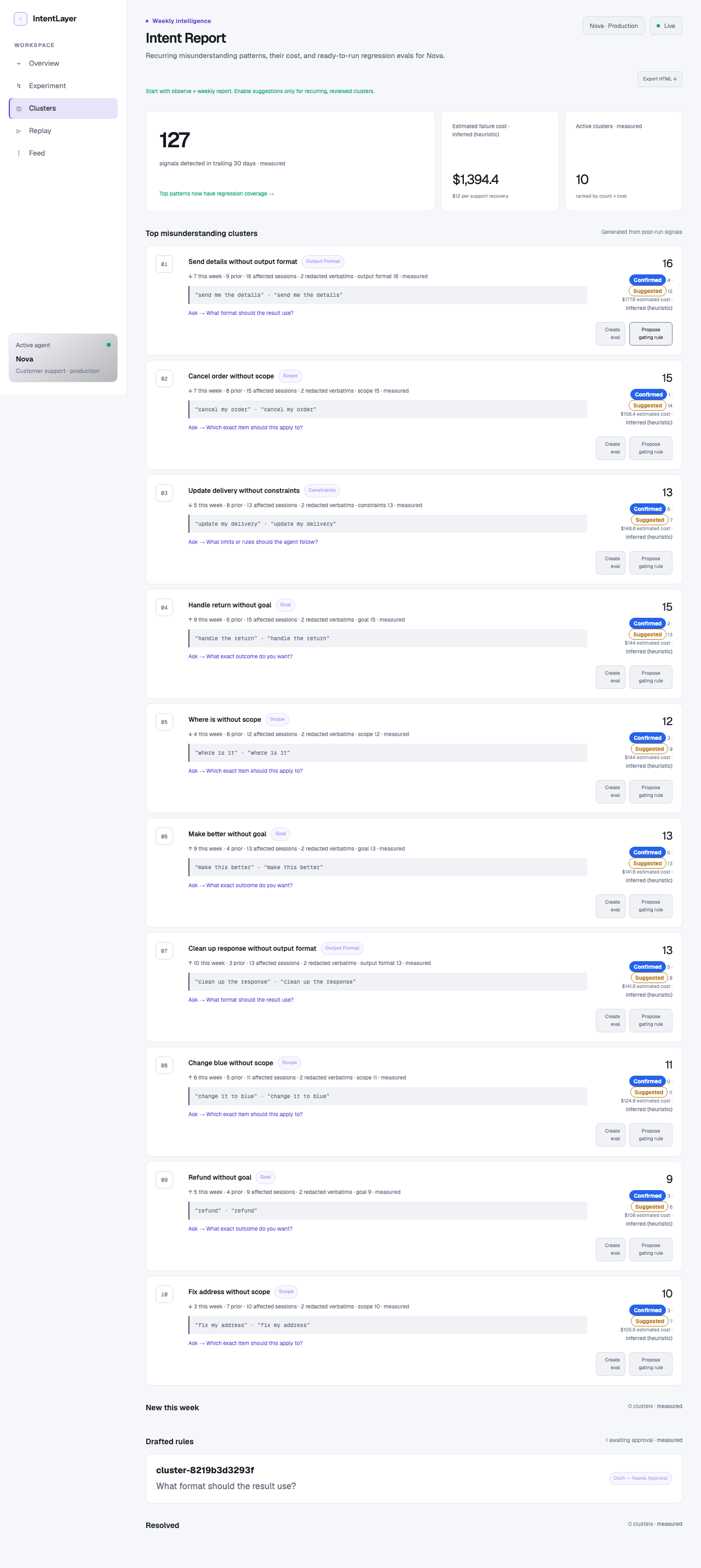
A weekly misunderstanding report your team can act on.
- Top misunderstanding clusters
- Exact missing dimension: goal, output format, scope, or constraint
- Representative request vs. actual user meaning
- Trend and estimated operating cost
- Suggested clarification question
- Ready-to-use regression eval
“Users seem confused.”
Repeated missing destination in refund requests, plus a tested question about card versus store credit.
eligible English WildChat conversations scanned
measured full scanprecision for explicit corrections in a reviewed sample
26 of 33 · LLM-judged, not human-verifiedagentic detector F1 on a repository-disjoint split
P 0.63 · R 0.80Start with evidence.
Scale with usage.
Plans are based on scored requests, not seats. Every paid plan starts with a 14-day white-glove pilot—no card required.
14-day pilot included
Startup
$99/ month
Up to 50,000 scored requests / month
- Trace logging and search
- Historical transcript import
- 3 outcome signals
- Weekly misunderstanding report
- Regression eval export
Best for one production agent or a first monitored workflow.
Start free pilot ↗For growing teams
Scale
$499/ month
Up to 250,000 scored requests / month
- Everything in Startup
- 20 outcome signals
- Issue alerts and digests
- Bulk data export
- Priority onboarding and support
Best for several agents, products, or high-volume workflows.
Choose Scale ↗Custom volume
Enterprise
Custom
Volume, deployment, and retention built around your stack
- Everything in Scale
- Custom integrations and signals
- Self-hosted deployment
- Custom retention and redaction policy
- Direct founder support
Best for regulated data, custom infrastructure, or larger volume.
Talk to founder ↗Send reviewed historical transcripts. Get a first misunderstanding report before connecting production.
Questions before you integrate.
Short answers on latency, privacy, setup, evidence, and the founding offer.
Does it add latency to my agent?
Not in observe mode when integrated as documented: scoring can run off the critical path, and outcome telemetry is asynchronous. Suggest mode does wait for the gate result because your app needs the questions before calling the agent.
What happens to user data and PII?
Liquet applies its configured redaction pipeline to request, context, history, event, and imported transcript fields before storing them. Redaction is best-effort, so you should also redact before the SDK, send only needed context, use opaque session IDs, and never send credentials or payment data.
Do I need to change my model or prompts?
No. The core integration is five lines: initialize observe mode, gate the message, run your current agent, then record its outcome—no model migration, prompt rewrite, or new orchestration framework.
Can I run it myself?
Yes. Run the full stack on your own infrastructure with Docker Compose; the repository quickstart is docker compose up --build.
What does “suggested” or “LLM-judged” mean on your numbers?
“Suggested” marks signals that are not explicit, reported corrections and therefore need review; “LLM-judged” means a calibrated LLM labeled the research sample, not a human reviewer. Read the methodology →
What does the pilot cost?
The 14-day pilot is free and needs no card. It includes help integrating the first workflow or importing historical transcripts, plus a first weekly misunderstanding report. Paid plans start only if the signal is useful.